Showing posts with label MoCCA. Show all posts

Wednesday, April 13, 2011

FEEDING GROUND _ MoCCA 2011 Wrap-up


Swifty, Chris, and I had ourselves a table at our first Museum of Comic and Cartoon Art Festival in NYC this past weekend.  It was a spacious and good-spirited event but I didn't have much of a chance to walk around to see what other creators were bringing to the table.  Really cool though to introduce new readers to FEEDING GROUND and to hear back from fans who have been reading along.  Below are a few other personal highlights from the weekend:


THE GATHERING
I had contributed art for a 2-page story in the premiere issue of this GrayHaven Comics anthology and Swifty and I are going to have another one in their upcoming Issue #4.  So, it was a sweet surprise to have been situated as neighbors right next to their table.  Led by Andrew Goletz, the anthology started as a forum for pairing first-time artists and writers from the Jinxworld message boards.  Wrapped with covers and art direction by the talented Aaron Bir, the collection is a fresh voice of dedication and enthusiasm. Writer Doug Hahner was also on hand. He wrote one of my favorite stories in Issue 1 and a nicer guy you never did meet.


THE INK PANTHERS SHOW

I devour podcasts as I work and this is the only one that disrupts my inking with laughter.  Ostensibly a comic podcast, the real attraction for me is the banter between friends Mike Dawson and Alex Robinson.  I was a cartoonist in college along with Mike and his professional work is one of the factors that encouraged me to get back into comics.  They've had me on the show in the past and this weekend I got to sub in for a stricken panelist at a live recording of the show at MoCCA, sharing convention stories with cartoonists Daniel Spottswood and John Kerschbaum and regaling the audience with my tale of destroying Capt. Lou Albano's car.  Also check out Mike's Pro T.I.P.S for more in-depth discussions with creators about the work and glamour of being a cartoonist.


MORE MoCCA BITS


-  I didn't get to see much, but the book LIAR'S KISS by Top Shelf was one attractive number that I planned on picking up.  Others agreed and it was sold out before I could grab it.

- I did get to buy GB Tran's VIETNAMERICA an incredible tome of personal journalism executed in a visual language that feels like memory to me.  Bonus - it came with the special convention cover that is a folded copy of a poster design for the book.

- I met one of my comic icons, Bill Sienkiewicz, and didn't embarrass myself all that much. I first discovered his work as a child with the “Badlands” issue of the "Demon Bear" run of THE NEW MUTANTS sandwiched between two other books in a supermarket 3-pack. It was a disturbing, challenging, find that not only opened my eyes to comics as art but the power of art in general. It continues to affect me and my work to this day. Check out this article on CBR to see images of the run and give yourself an idea on what sort of influence he had on the industry at a particular point in time.


- Swifty and I had dinner with our Editor-in-Chief at Archaia, Stephen Christy.  I am proud to be a part of a company that publishes important, attractive, work that is evolving our concept of what a comic book and comic book company can be in 2011.  Their recent Wonder Con announcements have me stoked as a comic fan, none more so than the care and vision that Stephen is putting into the graphic novel adaptation of Jim Henson's unpublished screenplay A TALE OF SAND.  Stephen is a guy who gets it, delivering quality packaging and promotion always in service of Story.

Friday, March 11, 2011

FEEDING GROUND _ On Storytelling


Last month, there was an excellent article on CBR's Pipeline blog by Augie de Blieck Jr. that evaluated the techniques of sequential art storytelling. The example he deconstructs is a scene by master cartoonist Stan Sakai from his epic USAGI YOJIMBO that, not the least of which, features a symmetrical panel arrangement to convey an ambush from both directions on a narrow mountain pass.


"Storytelling" as I understand it in comic book terms is the panel to panel communication of information. What are the decisions an artist makes in structuring and delivering a story that is coherent in orienting the reader and impactful in the delivery. It is often invisible when done correctly.


Comic creator Michael Moreci recently commented on his blog that he could see my storytelling get better with each page. Twas great to hear. Storytelling is a skill I've been working on since the challenges were first laid our for me on this book and the tools were conveyed in the series of classes I took at MoCCA as taught by comic legend Klaus Janson.


Since "storytelling" is the decisions that are made before the pretty drawings and I thought I would share some thumbnails here. The final storyboarding seems simple enough (and may seem rudimentary to some of you reading) but here are a few of the detailed decisions that went into it.


My main question: What is the goal of the scene and how do I convey that visually?


There's a scene in an upcoming issue of FEEDING GROUND that features a group of soldiers on a mission in which they are deployed in a vehicle that rams the main gate of a compound. The commanding officer is briefing the troops as they approach the gate and our protagonist is one troop who is a novice to the situation and consumed with anguish.


I inherently try to find the ticking clock of a scene to establish rhythm and here it's the moments leading up to the impact at the gate.


PAGES 0-1


The inside cover and first page of each issue of FEEDING GROUND features a double-page splash that includes the title and credit box and a scene that serves both as an establishing shot and also a symbol for the theme of the issue. In this case, BONUS, it's also a great capper to the last page reveal of the previous issue that it will follow in the collected edition.


The gate will be presented here from below and towering right of center (Western reading runs from left to right) and lit by an off-panel rising sun. There will also be clouds lit behind it to sell the effect. Also, most issues tended to begin with an animal of some sort, represented here in the form of roadkill in the foreground that will carry over to the reverse shot on the next page…


PAGES 2-3


...where the first panel will reveal the approaching convoy under the rising sun. The first choice is to decide what sort of panel grid I'll be using. Since this scene plays very much like a comment on tough guy action movies, I opted to use "widescreen" dimensions for each panel.


There is also a push and pull between the external action of the moment and the internal struggle of the protagonist (marked with the S and stripe on his chest - these ARE rough and usually just for me and Swifty and Chris). With that, notice that I have the panels get bigger to the point of impact and then reduce back down on the close-up of the protagonist in the final panel on P3. Since both pages will be visible to the reader, I always try to design across the spine with the full spread in mind, especially if the pages are within the same scene.


To support the action further, I chose to alternate between interior and exterior shots that will flicker between light and dark and add rhythmic tension to an otherwise dialogue-driven scene. Likewise, I keep reversing the point-of-view in this sequence. In order for it to still read clearly, I try to design the content of each panel such that the reader's eye will be led in a Z pattern through the page and that there are background elements that will always orient the reader.


Our protagonist leaves the darkness of the vehicle in the second panel of P3 but I also made a choice that the words of the commanding officer will continue to play out in narration boxes over the action of the final two panels. An off-panel voice should offer a sense of disassociation that gives the impression of being in the protagonist's head as he enters combat in a rage-fueled stupor.


The Next Question: How do I execute it?


After all of these decisions are made, the job is to make sure that the illustration style, inks, color, lettering, word balloon placement, and sound effects all support the original goal and that the art engages with the dialogue (and vice versa) in some charged fashion.


The payoff of one scene in a comic should be greater than the sum of the art and writing.


Monday, April 12, 2010

The MoCCA Festival 2010 _ Cartoonists in Search of a Living Wage


Apologies for the lack of more regular posting. I'm proud to say it was partly due to the time I've been dedicating to finishing the coloring and lettering of Issue 1 of my comic Feeding Ground. It's off of my plate and, this week, onto Issue 2...

I'll soon return to talking about the color of the book and please post any inquiries you may have.

Instead, I just came off a comics community weekend with a book launch party at Art Spiegelman's apartment (!?!) and the annual MoCCA festival and thought I'd give some insight into the logistics of making this comic happen.

Based on current reading and my experience at the MoCCA festival, the comics scene is more diverse that I've ever seen it. The tables and bookstores are populated with memoirs and historical work, the literary and the vulgar, art objects and genre fiction of all stripes. There were more women on both sides of the tables than at any comic event I've attended and the number of "fangirls" in the genre market also appears to be growing. All said, the comic community remains strong even as the economy wobbles. And yet, artists that make a grab at living on comics seem to face a low ceiling.

In terms of "Fine Cartoonists" just how much is a customer willing to spend on a photocopied zine or its more expensive cousin, the silkscreened art object, when book publishing has become glossier and more inclusive? Likewise, it was never easy to nail a full-time contract with one of the Big Two (Marvel and DC) but it's become even more difficult with the open pool of international talent now available an e-mail and file server away. And, what about me? What does it mean to work on a creator-owned comic in 2010?

In short, it pays nothing up front and every week is a balancing act of long hours of non-paying comic work alongside searching for and delivering on whatever freelance jobs I can acquire. I have cut my rent in half by moving from an apartment in Park Slope, Brooklyn to the first floor apartment in my family's two family New Jersey home. I've got my dog, cat, and lady but visiting friends has become the occasional outing.

Now, I'm happy with what I'm doing and appreciate the challenge. Comics have long been a love of mine and now I have the chance to develop that skill set and participate as a peer. But, at the end of the day, I can't say that this is a way to make a living.

As a career animation designer, I always looked for the opportunity to pitch my own ideas for series to different networks and studios. In part, I do feel like I have something unique to bring to the table but there's also that brass ring chance of escaping the freelance cycle and getting paid to work on something that is your own.

In the case of this comic, we could have gone the self-publishing route and we have enough faith in the material to do so. But, we were fortunate enough to partner with a publisher, Archaia, who believes in the medium and our work. I'm taking a chance that our book may sell enough to recoup some of my expenses but I also understand the time it will take to do so when divided up among all three creators. Comic purists also decry a perceived money grab at comics that are developed into other media like video games or film but I could only hope that our work is potent enough to capture broader attention.

There is the oft-repeated credo that cartoonists do the work they do out of the love for it and not out of a desire to get rich. But, what about basic compensation for the work done by comic illustrators on work that is not their own? Maybe someone else can shed more light on this, but, in an age when major book publishers all have a comic arm, are their cartoonists making enough to pay the bills? Anecdotally, I can tell you that it's not always the case.

I've had the pleasure to be able to meet with professional cartoonists whose work I admire. I won't pretend to understand the finances of book publishing but something seems to be amiss when these artists work for reputable houses for what amounts to less than a living wage. I'm not saying that there's necessarily anything underhanded at play. Comics are time-intensive, laborious work in which the "love of the game" is factored into the financial model.

In my case, I need to get back to working on Issue 2. And then, after that, along with the good people of Archaia, I'll also need to bust my butt to get out there and sell it.

Wednesday, February 10, 2010

COMIC EVENTS 03 _ MoCCA Thursdays

Just wanted to give a heads up to those in the NYC area about the incredible programs at the Museum of Comic and Cartoon Art in Manhattan every Thursday night in February.

This week is:

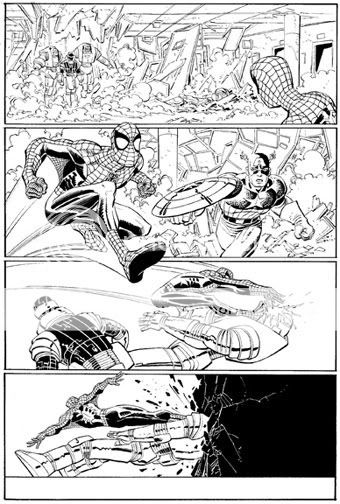
**Spider-Man: 25 Years of Amazing

Thursday February 11th, 7 PM
Admission: $5 | Free for MoCCA Members **

With a full round-table discussion with many Spider-Man editors and writers past and present along with a full issue of original John Romita Jr./ Klaus Janson art on the walls.


Next week is an amazing meeting of the minds/ worlds for me. I've worked in NYC Animation for over ten years, primarily at Nickelodeon, and only recently started to try my hand at comics. I've taken a class at MoCCA and was floored by their Dave Mazzuchelli exhibition a few months back. Now, they'll be highlighting the other "C" in their name by having Nickelodeon's animation director Dave Levy talk about the process of pitching cartoons for series.


I worked with Dave when he was Animation Director on Blue's Clues and he is extremely passionate and informed about his calling. Dave has served as the head of ASIFA East, written a a book about Animation Development and another informative book on the culture of being an animation professional, and his talk is sure to be insightful for anyone who is curious about getting their foot in the door and making a job of making cartoons.