Showing posts with label Dave Mazzucchelli. Show all posts

Monday, April 19, 2010

COMIC COLORING 02 _ Color As Narrative

Color's a very powerful thing, and I hate to see it squandered. I think there should be more black-and-white books, not only because they can work very well, but if you don't use color for a purpose, why waste the ink?
- Frank Miller
I believe color is used essentially as a packaging device, rather than as an integral storytelling device.
- Will Eisner
I'm not much of a draftsman. When it came time to design "Feeding Ground" I had to consider the tools in my belt and how I could best communicate the narrative visually. I've needed to hone my drawing ability to the task but the skill that came most naturally, the implement that I felt I could wield most expressively, was color.


For a horror story taking place in the heart of the Mexican desert, I needed colors that would bleed and vibrate off of the page as if the ink had spoiled. Colors that are lurid and garish and feel a little sick. There are colors that describe what a thing is, be it skin, a sky, or hair. Then there are colors that convey a quality of light, from the artificial to the changing mood of the sun. Those are the colors of reality. My goal has been to combine those qualities with the emotional weight of color to create a world that feels simultaneously unreal and a more realized version of the place itself .

Coloring in mainstream comics has never looked more professional. Digital colorists can now create highly rendered forms and special effects akin to a summer blockbuster. But, at its best, this sort of coloring is an invisible art in that it conveys only what is on the surface.

Narrative color has been used recently by David Mazzuchelli in his Graphic Novel "Asterios Polyp." He follows a clinical formula with a limited palette of primaries and secondaries to convey emotions and mental states as directly as the time of day. He combines them to visualize invisible connections between characters in a visual language that is as stark as thought balloons or the written word.

For my tastes, Val Staples color work on "Criminal" by Ed Brubaker and Sean Phillips is even more inspiring for using bastard colors like mustard, mint green, and violet to elicit feelings from the reader. They aren't the "right" colors for, say, the restaurant setting of a scene, but they perfectly conjure the acrid ozone smell of electric violence in the air.


The color work in my book feels risky. I'm often doubting myself and arriving at solutions through accidents but that's what makes it art to me. The trick is that I need to know when to reign it in. I'm using color hold outlines, and overlays, and unnatural hues and it could all turn out to be a chore on the eyes if I'm not successful.

There was a point when my final black and white inked work looked like enough to me. With a little local color, it read fine and looked right. It was a safe option. But, we sold our pitch book with color that didn't compromise. I had to follow our initial impulse and chase colors that not only felt "right" but might cause the reader to see something new.

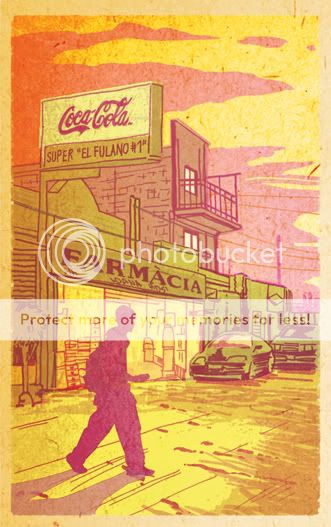


Note: the entire story is not told in silhouette. I had to pick images that didn't give up too much information and just noticed the common thread in all of these panels.

Thanks to cartoonist Donal Delay for bringing the featured quotes to my attention.

Thursday, January 21, 2010

COMIC INFLUENCES 01 _ Ed Hannigan


Creating comics can be a drawn out, time-consuming process. My mind wanders as I render for hours, understanding and illuminating aspects of the story that had not yet been apparent to me. But, there are moments when it is impossible for me not to weigh my work against all of the other comics produced before me as well as those of my contemporaries.

Do I tell a story that utilizes the economical realism of a Batman: Year One-era Dave Mazzucchelli or will the story be better served by the seemingly spontaneous and chaotic panel and character explorations of Bill Sienkiewicz? Even as my "style" and process have been regulated, there are lessons and challenges that all other art continually poses to keep me fresh and honest with each panel. It can also be daunting on a bad day.

I wanted to push some pixels here to honor an influence who was one of the forces that inspired my devotion to this medium but whose name I only recently discovered.

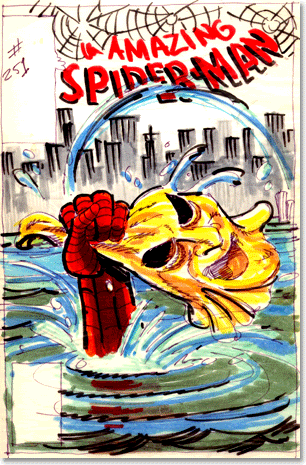
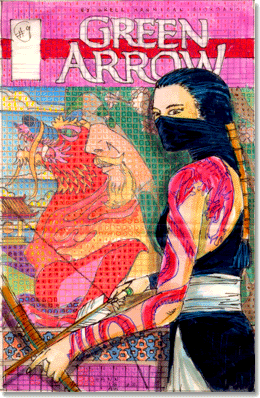
His name is Ed Hannigan and his was the silent hand drafting many concept sketches for Marvel covers during the formative years of my comic collecting.


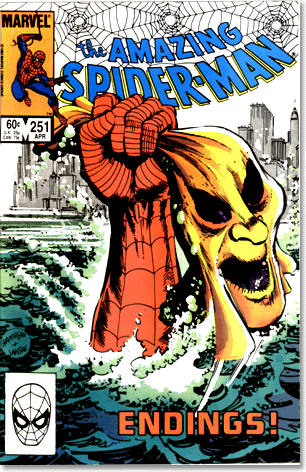
I'm almost positive there were other comics I bought and read before this Amazing Spider-Man #251. Up until this point I was a Spider-Man fan primarily because I met him at the Grand Opening of a local appliance store.


I was unaware of the Hobgoblin and the mystery surrounding him but this particular image screamed of such peril that I had to know what was happening. This was the image, a single image that is densely packed with story and drama, that told me that art could speak volumes and elicit intense emotions. And, it does so by illustrating a moment that doesn't even show the combatants. This was cover art as STORY, not pin-up.

Coincidentally, that cover was inked by Klaus Janson, who I now have the great honor and pleasure of calling a teacher.

Ed was schooled by some of the Marvel Masters like John Romita and Jack Kirby but I didn't grow up in that era. It was his play with type and illustration and design that contributed to my appreciation and professional/ playful relationship with those same elements to this day.

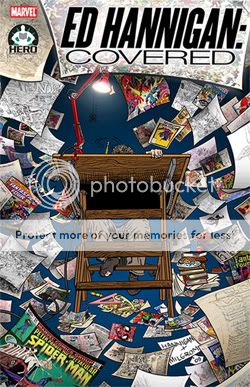
He has literally covered the entire Marvel Universe by serving as the designer and illustrator responsible for the character-packed covers to "The Official Handbook of the Marvel Universe." Each was its own design puzzle and then they all interlocked to form a poster the size of a small NYC apartment.


Unfortunately, the reason his name has come to my attention is because he is battling Multiple Sclerosis and The Hero Initiative is championing his work and seeking donations to defer some of his medical expenses. Comics don't have a retirement plan or union and The Hero Initiative has taken on the role of encouraging fans to provide a safety net for those in need.


I'm glad to know Ed's name to thank him for being one of those influences that encourage greatness. Also thanks to The Hero Initiative for collecting a comic of his work so that I may study it and produce work that may live up to his legacy.

You can donate on their website and buy the collection Ed Hannigan: Covered at your local comic shop. And, you can buy or commission art by Ed here.